I’ve reached an inflection point in life that is leading to a change in how I make decisions about where my time and attention go. The reflections below were initially for me to understand these issues more clearly, and they are public (but very hard to find, outside of my email autoresponder) for anyone who might find this interesting for their own purposes.
One Way to Balance a Life
We all have many domains in life that we do our best to manage.
Mine, in no particular order, are: marriage, work, recovery/reserves, parenting, fitness, nutrition, creating art, physical environment, social connection, mountain adventures, and managing my lung stuff.
There are other things that I do of course, but these domains are the areas of life where I spend most of my energy and attention. These are domains that I can mostly control, and my efforts across these domains determine how close my actual life is to the life I want to live.
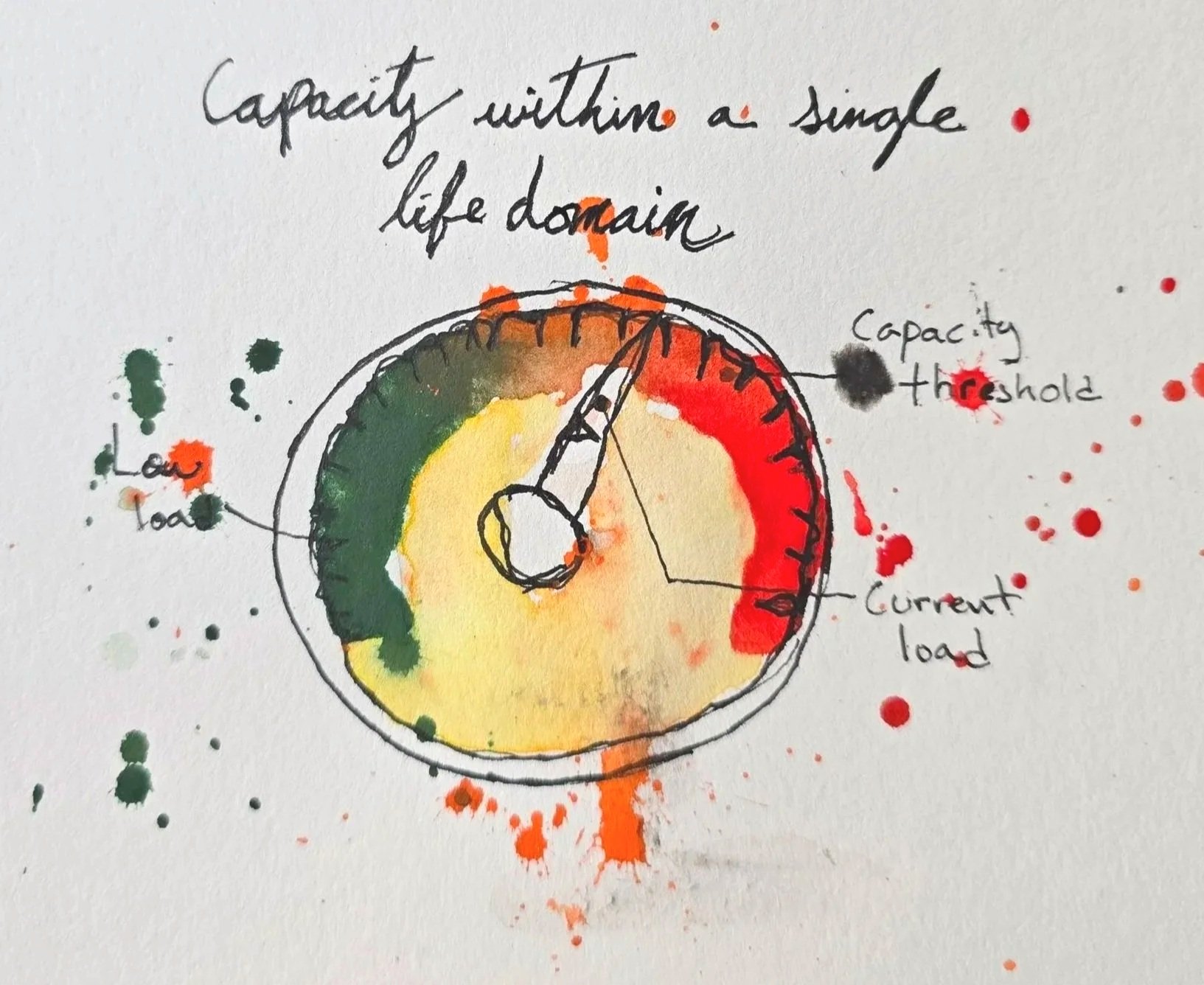
In my mind, each of these areas has its own little RPM gauge. On each gauge, the little needle that moves from high to low reflects the total load I’m experiencing from that domain at the time. If the little needle is near the threshold of the redline, it means I’m starting to get close to my capacity threshold in that domain, beyond which my efforts in that domain become unsustainable.
It is possible to operate beyond the redline threshold, and sometimes you have to or you want to. But you can’t do it for too long without other domains (and your overall quality of life) starting to suffer, then deteriorate, then collapse, then crash and burn.
On Superpowers
A colleague of mine defines a person’s superpowers as, “the things that have made you good at the things you’ve been good at for as long as you can remember.” For example, one of his superpowers is to see potential in people that they can’t see for themselves, and reflect it back to them. He’s HNC’s Director of Strategic Communication, so that makes sense.
I’ve identified about 4 distinct superpowers in myself, but that’s a conversation for another day. The one that’s relevant to this conversation is: I’m very good at sensing how close I am to a threshold and controlling exactly how close my RPM needle gets to the redline.
Living the Life I Want…Without Burning Out
I’ve been able to build the life I want to live. This is very different than saying I have built a perfect or an easy life. A perfect or easy life is not the life I want.
The life I want to live is about purpose and excitement and connection. Those things are difficult to build and maintain. To sustain purpose and excitement and connection, you have to do hard things often.
This superpower has made it possible to operate on the very tip of the tip of the bleeding edge of my capacity across most domains in my life. In other words, I’ve gotten really good at pushing my capacity in almost all 11 domains right up to the limit of my capacity simultaneously, without tipping into the red.
I’ve come to understand the physics of how these domains work, and I can intuitively calibrate load across each domain very precisely. As you put more and more effort into any domain, you experience more of its benefits, but the wear and tear takes a proportionate toll. This is why one of my domains is “recovery/reserves”.
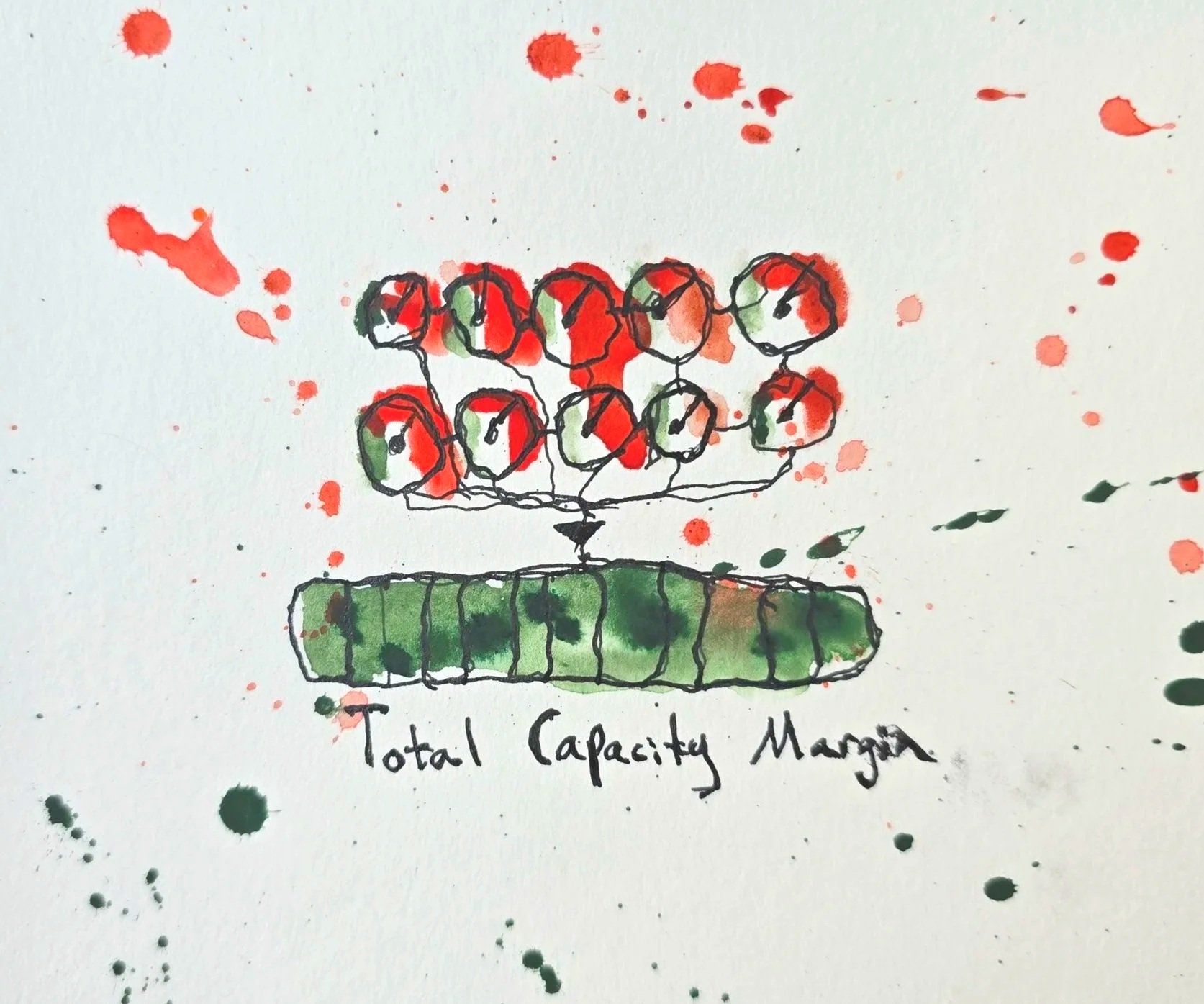
Now, imagine the distance between the redline threshold and the location of the needle at any given time. This represents the unused capacity you have in that domain. Then, take those 11 little slivers of capacity, and add them up: this is your total capacity margin in life. Margin, meaning the wiggle room you have before you max out your total capacity.
I’ve been operating on an extremely small total capacity margin in life for the past couple of decades. This has been possible because my superpower means that I understand the physics of how these domains behave. And this in turn is a big part of why I’ve been able to create the life I want to live. I’m able to take on lots of very hard things across domains simultaneously, while ensuring that I stay within my sustainable capacity margin…well, at least that’s been true for almost all of the past couple of decades…
When your total capacity demand exceeds your total margin, you have serious problems. You crash and burn. This has happened to me 3 times in the last year, and it’s taken a while, but I now understand why (and what to do about it).
What Happened Over the Past Year?
One of those 11 domains is new(ish): parenting.
I disagree with most of the platitudes people like to foist upon others about parenting—things people say like: your life is now about your kids, you can’t have dedicated time for yourself, your kids take priority over your other passions in life, and so on. I don’t dispute that many people believe these things. But these are beliefs people hold, they are not facts about the world. Marie Curie, Jacinda Ardern, Ruth Bader Ginsburg, and Theodore Roosevelt are some of my favorite role models when it comes to people who have prioritized both (1) very intentional parenting and (2) pursuing their passions at a high level. It’s not for everyone, because it takes herculean effort and intention, but it is possible.
What I have found interesting, though, is that the parenting domain operates according to a fundamentally different set of physics than all my other domains in life.
The other domains can affect one another, sometimes dramatically. Losing a job, experiencing a health crisis, or going through the death of a loved one can ripple across every other area of life. But those events are relatively rare. Most of the time, the load within a domain remains largely contained to that domain.
But the parenting domain introduces a fundamentally new law of physics: overload in the parenting domain can frequently decimate capacity across nearly every other domain simultaneously, with little to no warning.
For example, you get a surprise call from school on a Wednesday to pick up your sick toddler, and your spouse is on a work trip for the next three days. Little bud isn’t going back to school til next week. You are now full-time childcare. Capacity in the domains of work, fitness, nutrition, etc drop to near zero. BUT…the challenge is that the demands in those domains don’t disappear just because your available capacity does. Work still needs to get done. The home environment still needs to be livable. Perhaps you still have responsibilities to others in your life. The result is that the total effort you must expend suddenly exceeds your total capacity, pushing you into an unsustainable operating state.
When you operate beyond capacity, you are using reserves. I’ll avoid getting into the weeds of what I’ve learned about the physiology and neurobiology behind all of this, but there is a progression that starts as soon as you begin operating on reserves for more than just a short time: (1) allostatic overload, then (2) functional exhaustion, then (3) clinical burnout, then (4) breakdown.
Over the past 10 months, I’ve come dangerously close to clinical burnout. BUT… I have actually not experienced burnout in the way people talk about it in day to day conversations (they talk about exhaustion, a loss of passion, hopelessness, etc)—I never lost passion, I never lost focus, I performed at a truly best-in-the-world level in one very specific area…but my energy reserves paid an extreme price.
The symptoms of functional exhaustion/burnout—bordering on clinical burnout—that I am experiencing (and working my way out of) have been physiological and neurobiological: progressively longer illness recovery periods, progressively reduced exercise tolerance, hypersensitivity to uncertainty & threat signals, HRV/RHR/RR biometrics tanking, and a desensitization to historically effective recovery modalities. These are serious problems in and of themselves, but they are also warning signals that I was approaching clinical burnout.
These two types of burnout are very different beasts. You can recover from functional burnout with an intentional plan, like mine that I’ll link below. But recovering from full-on clinical burnout can take years, during which your ability to function and contribute at a high level is essentially nil.
What I’m Doing About It
Like all areas of life, recovery benefits from planning. Not rigid planning, but resilient planning.
As an aside, this is also an interesting pattern that showed up when I interviewed dozens of parents before our little bud came. One group of parents said some version of, “You can’t plan or prepare for parenting, so your efforts to plan are in vain” (this perspective usually comes with a fair amount of condescension). The other group said some version of, “You can absolutely plan and prepare, and it’s extremely helpful if you approach it right.”
Through my interviews, it became clear that the first set thought of planning as creating specific plans that they intend to stick to (rigid planning), while the second group thought of planning as learning about the principles and systems related to parenting topics and using these principles to create and iterate on their approach to this or that aspect of parenting (resilient planning).
The process I’ve gone through over the past several weeks, which has led to the creation of my Reserve Recovery Plan, has looked something like this:
Triage by dramatically reducing total load so I can figure everything else out (reduce as many stressors as possible)
Develop a clear understanding of the mistakes I made over the past year (my incorrect decisions/ actions/ oversights/ etc that led me to this functional exhaustion)
Develop a clear understanding of the specific mechanisms that caused my deteriorating resilience (e.g., chronic allostatic overload, threat system dysregulation, effort-recovery failure, and so on)
Understand the overarching shape of recovery needed, given my specific underlying failure mechanisms, and my very specific history, circumstances, goals, etc
Build a periodized recovery plan, built on the cutting edge of humanity’s understanding of the 5 types of recovery I need to invest in: physiological, autonomic, cognitive, identity, and awe recovery
I’m fortunate to have access to incredible, world-class experts and coaches on these types of recovery, and this has enabled me to plan an initial macro-recovery phase that will last roughly from June through September.
I call this an “initial phase” because it is just the first stage of building a new, more sustainable operating system for the next phase of life. The goal is not just to recover from the past ten months. The goal is to recover in a way that better accommodates the realities of all the domains of life I intend to balance.
One final point: people often confuse recovery with resting. They are not the same thing.
Resting is about reducing effort. Recovering is about investing in the capacity reserves that were depleted. Both are relevant to my situation, but they are very different concepts.
For those who are interested in my Reserve Recovery Plan, I’ll link to it here soon. I need to finish some fine-tuning. It’s very thorough and intentional, as anyone who knows me might expect, but it will be constantly revised as I discover what’s working and what’s not (resilient planning, not rigid planning).
At a really practical level, I’m going to be changing the filters that determine how I use my time and energy, especially during this recovery period.
I’ll be saying “no” to most professional requests, or requests that don’t directly align to my recovery goals or activities. It’s probably obvious, but part of the problem is that I do usually want to say “yes” when people request time, when they think there’s something helpful I can contribute.
As I say that, I hear my past executive coach’s favorite question in my head: “…and how’s that going for you?”, to which I respond, “…not as well as I’d like.” There’s probably a time when I’ll say “yes” to more requests again, but not now.
I intend to continue doing this work for decades, so I have no choice but to focus on rebuilding my reserves.